4 Weeks To Go Until The Summit
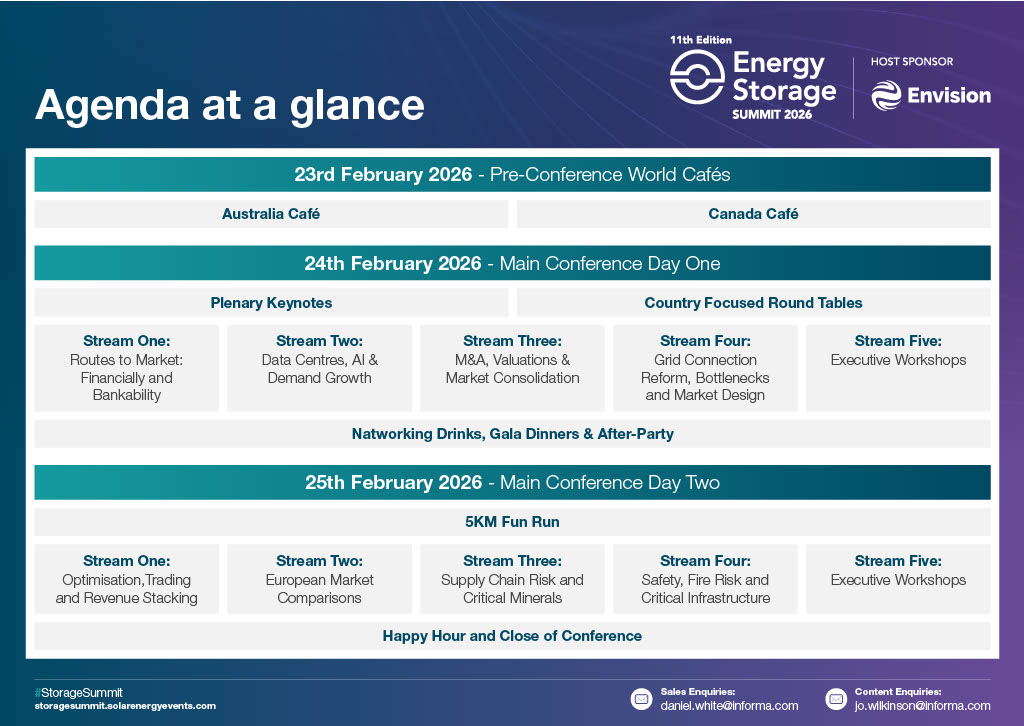
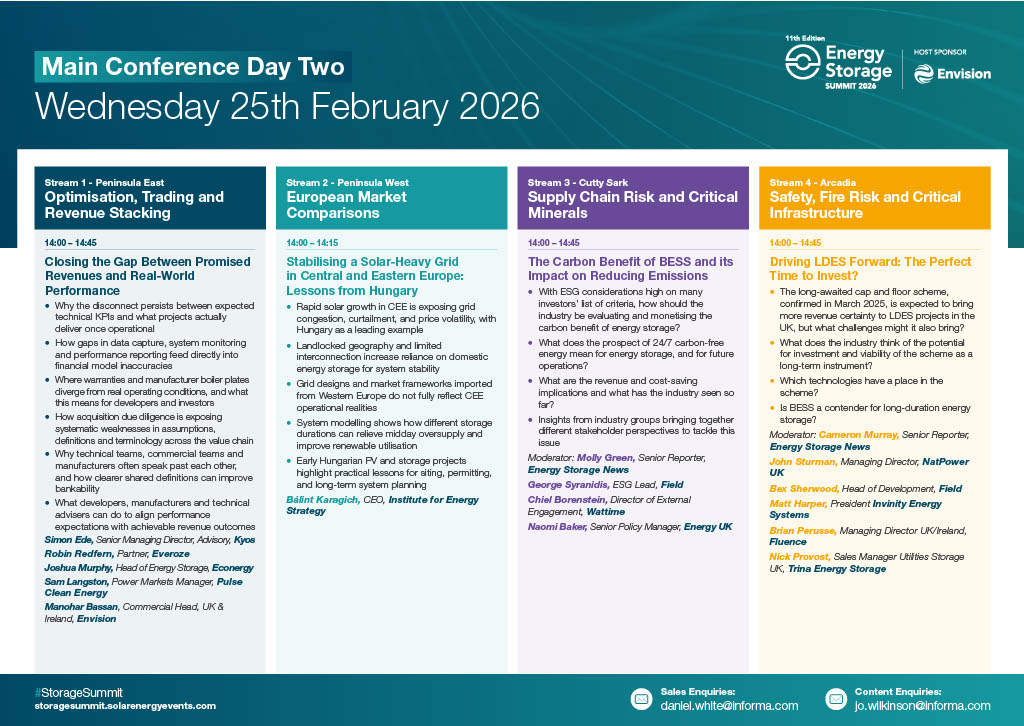
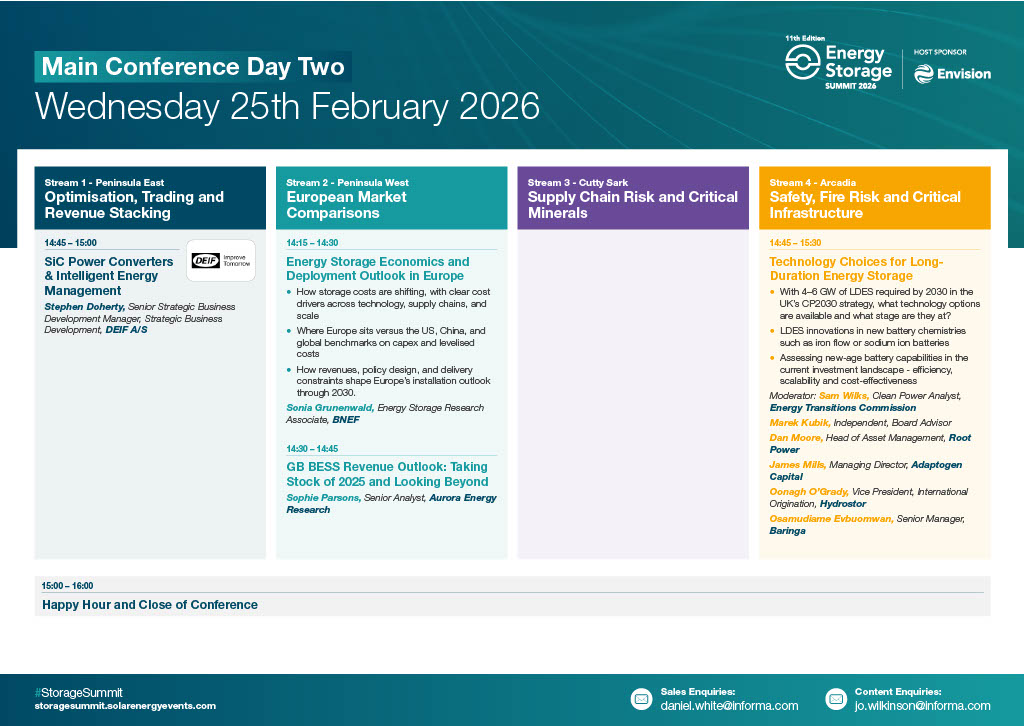
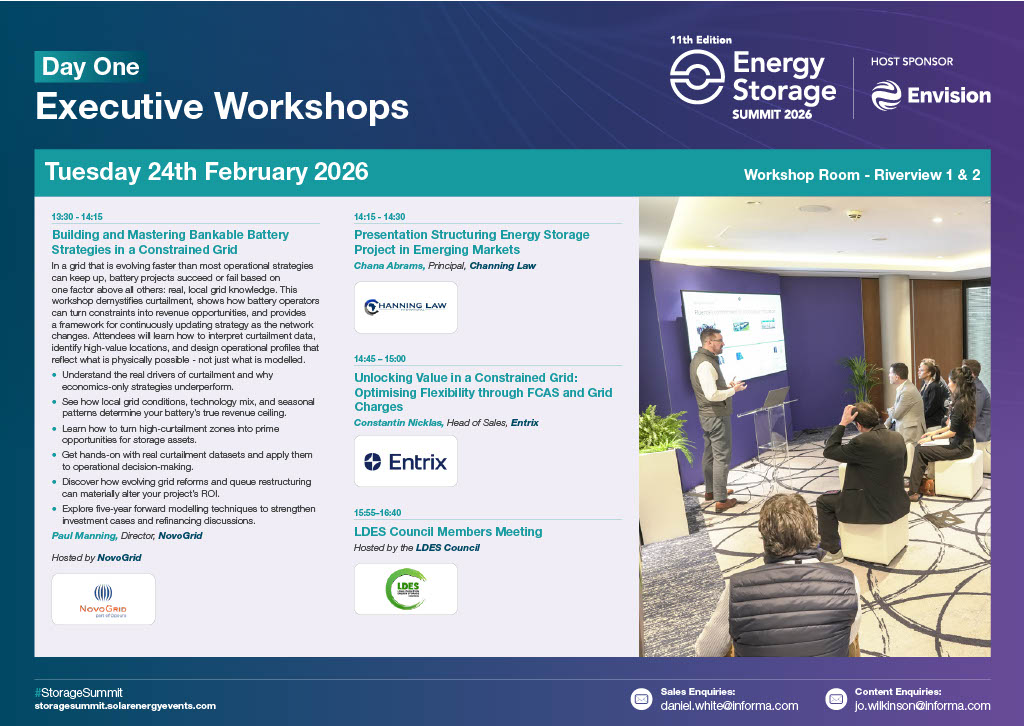
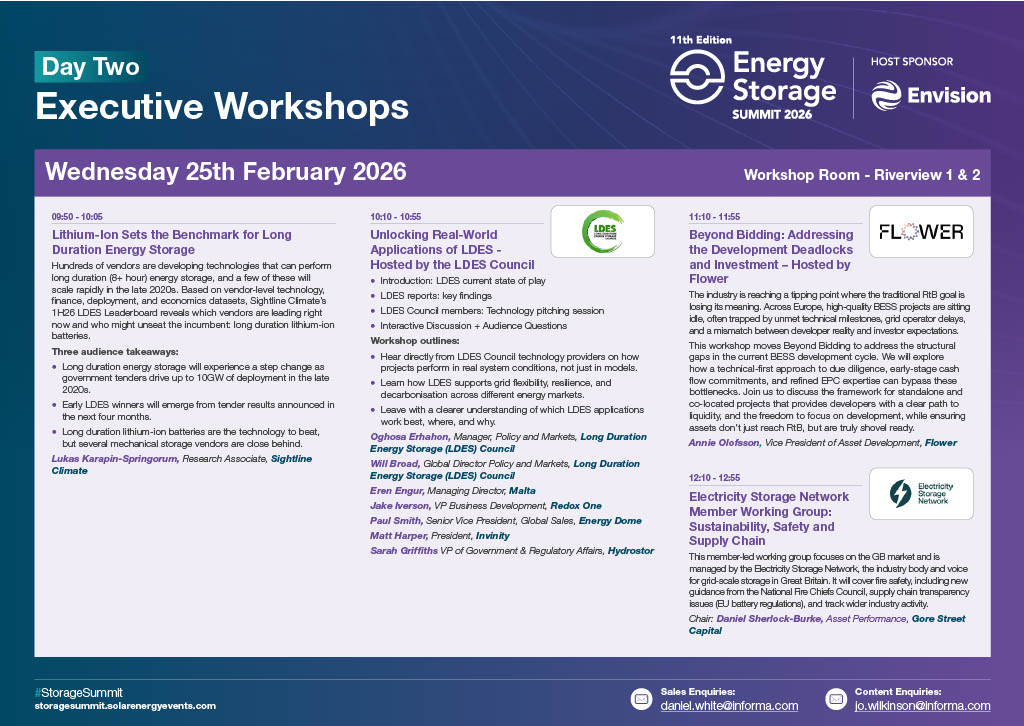
2026 Agenda
Interested in speaking on a panel, or giving a presentation?
Get in touch with the Energy Storage Summit team to find out how you can get involved.
Interested in speaking on a panel, or giving a presentation?
Get in touch with the Energy Storage Summit team to find out how you can get involved.
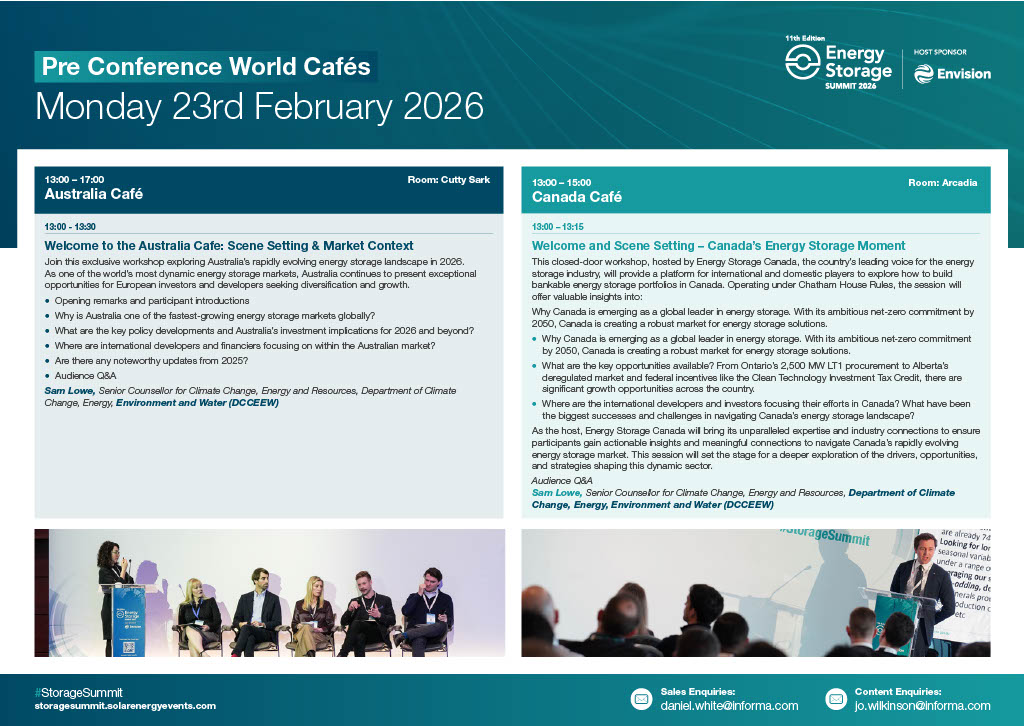
Join this exclusive workshop exploring Australia’s rapidly evolving energy storage landscape in 2026. As one of the world’s most dynamic energy storage markets, Australia continues to present exceptional opportunities for European investors and developers seeking diversification and growth.
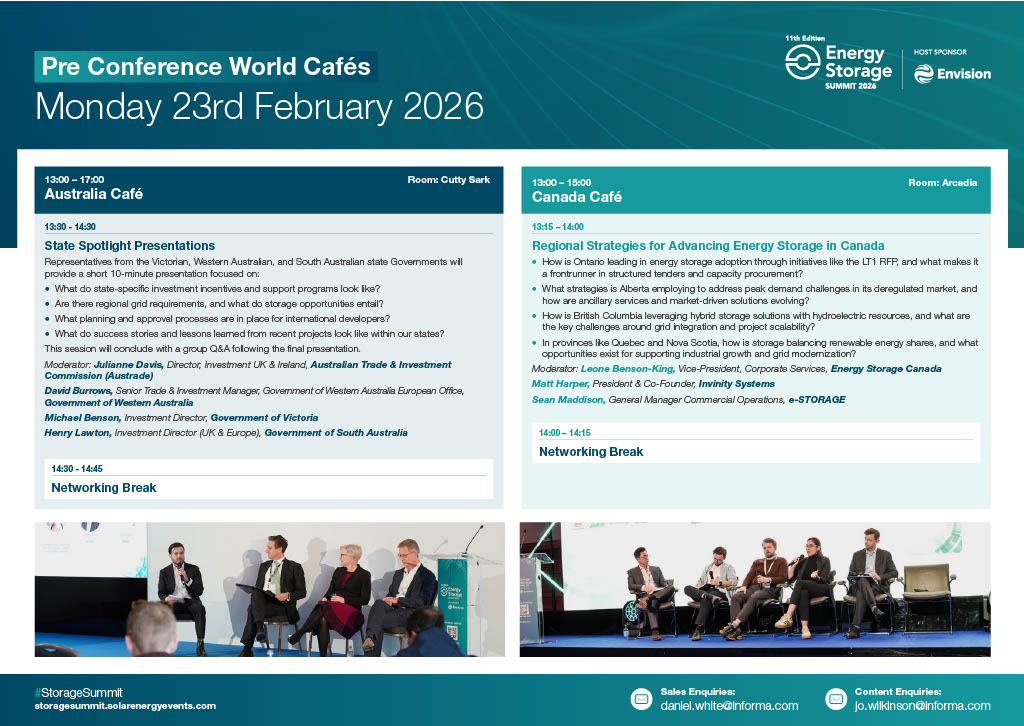
Representatives from the Victorian, Western Australian, and South Australian state Governments will provide a short 10-minute presentation focused on:
This session will conclude with a group Q&A following the final presentation.
This closed-door workshop, hosted by Energy Storage Canada, the country’s leading voice for the energy storage industry, will provide a platform for international and domestic players to explore how to build bankable energy storage portfolios in Canada. Operating under Chatham House Rules, the session will offer valuable insights into:
As the host, Energy Storage Canada will bring its unparalleled expertise and industry connections to ensure participants gain actionable insights and meaningful connections to navigate Canada’s rapidly evolving energy storage market. This session will set the stage for a deeper exploration of the drivers, opportunities, and strategies shaping this dynamic sector.
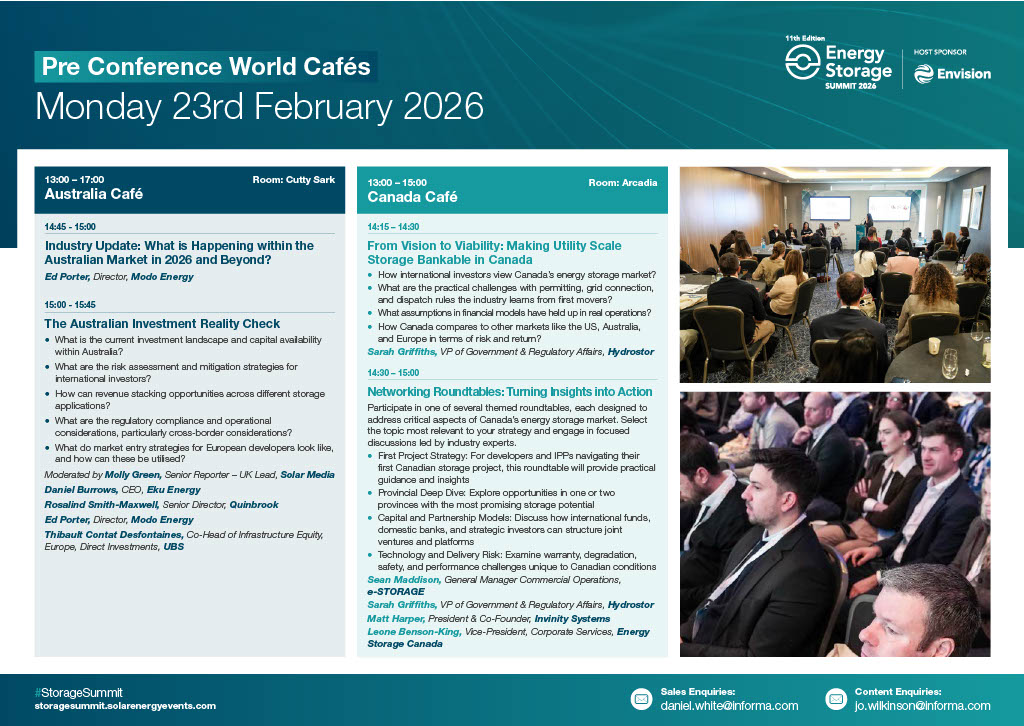
Participate in one of several themed roundtables, each designed to address critical aspects of Canada’s energy storage market. Select the topic most relevant to your strategy and engage in focused discussions led by industry experts.
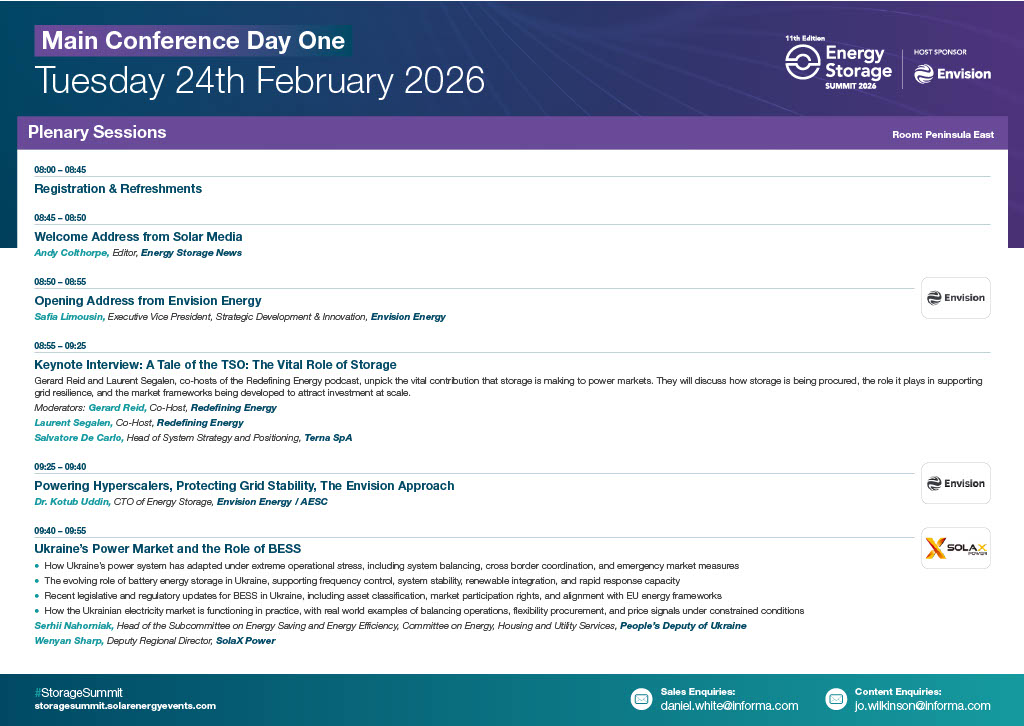
Gerard Reid and Laurent Segalen, co-hosts of the Redefining Energy podcast, unpick the vital contribution that storage is making to power markets. They will discuss how storage is being procured, the role it plays in supporting grid resilience, and the market frameworks being developed to attract investment at scale.
Chatham House Rules

![]()
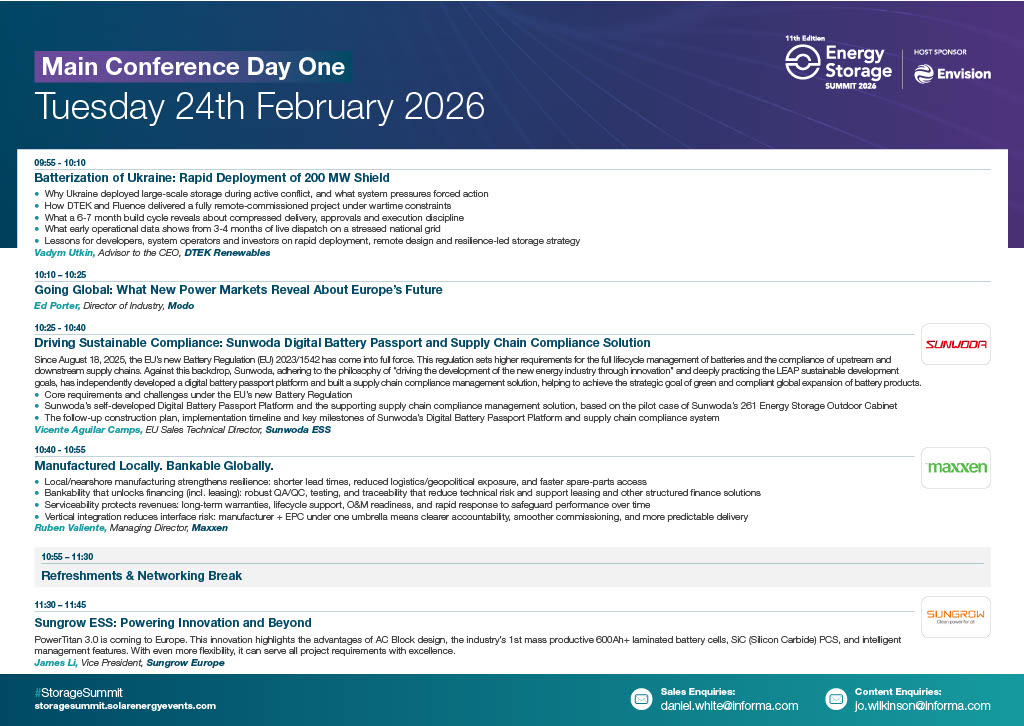
Since August 18, 2025, the EU’s new Battery Regulation (EU) 2023/1542 has come into full force. This regulation sets higher requirements for the full lifecycle management of batteries and the compliance of upstream and downstream supply chains. Against this backdrop, Sunwoda, adhering to the philosophy of “driving the development of the new energy industry through innovation” and deeply practicing the LEAP sustainable development goals, has independently developed a digital battery passport platform and built a supply chain compliance management solution, helping to achieve the strategic goal of green and compliant global expansion of battery products.
![]()
PowerTitan 3.0 is coming to Europe. This innovation highlights the advantages of AC Block design, the industry’s 1st mass productive 600Ah+ laminated battery cells, SiC (Silicon Carbide) PCS, and intelligent management features. With even more flexibility, it can serve all project requirements with excellence.

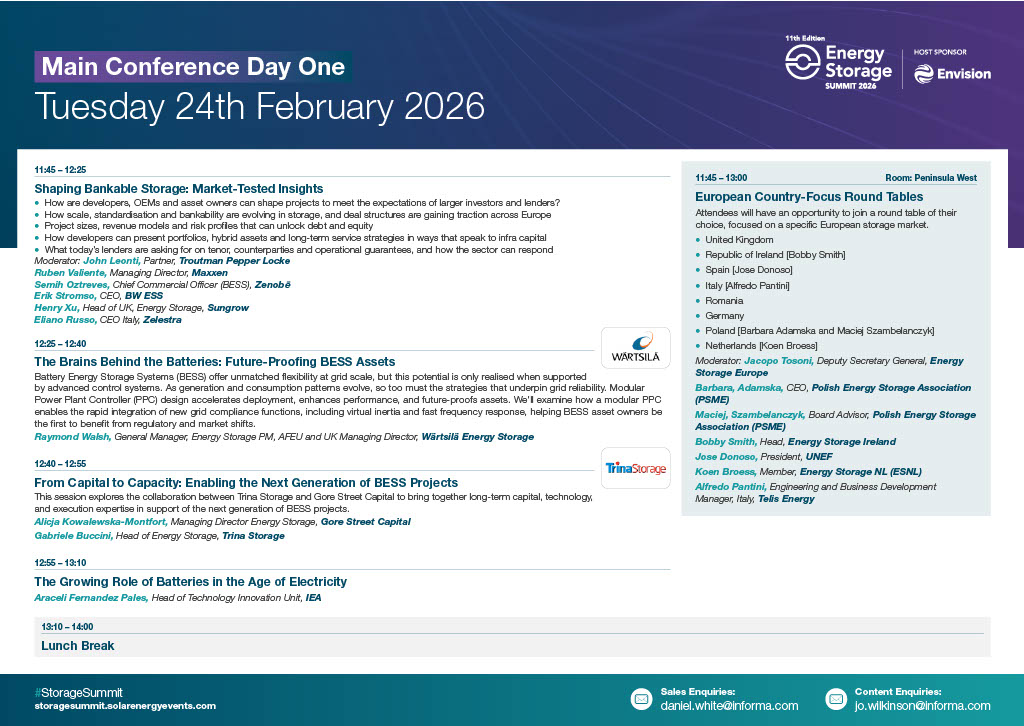
Attendees will have an opportunity to join a round table of their choice, focused on a specific European storage market.
• How are developers, OEMs and asset owners can shape projects to meet the expectations of larger investors and lenders?
• How scale, standardisation and bankability are evolving in storage, and deal structures are gaining traction across Europe
• Project sizes, revenue models and risk profiles that can unlock debt and equity
• How developers can present portfolios, hybrid assets and long-term service strategies in ways that speak to infra capital
• What today’s lenders are asking for on tenor, counterparties and operational guarantees, and how the sector can respond
Battery Energy Storage Systems (BESS) offer unmatched flexibility at grid scale, but this potential is only realised when supported by advanced control systems. As generation and consumption patterns evolve, so too must the strategies that underpin grid reliability. Modular Power Plant Controller (PPC) design accelerates deployment, enhances performance, and future-proofs assets.
We’ll examine how a modular PPC enables the rapid integration of new grid compliance functions, including virtual inertia and fast frequency response, helping BESS asset owners be the first to benefit from regulatory and market shifts.

This session explores the collaboration between Trina Storage and Gore Street Capital to bring together long-term capital, technology, and execution expertise in support of the next generation of BESS projects.


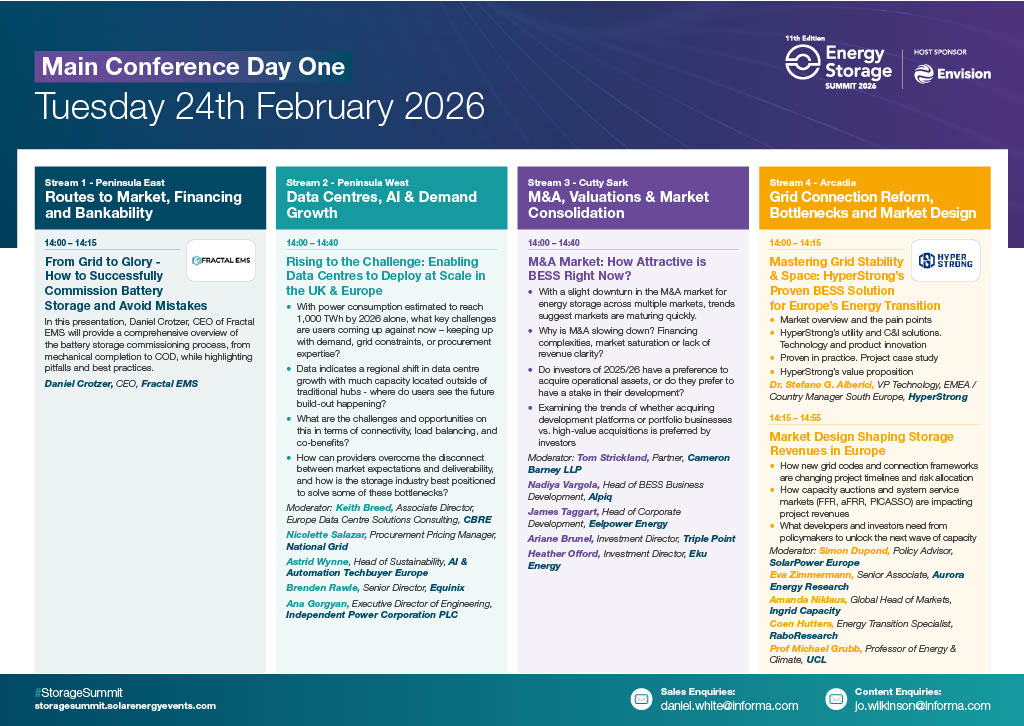
In this presentation, Daniel Crotzer, CEO of Fractal EMS will provide a comprehensive overview of the battery storage commissioning process, from mechanical completion to COD, while highlighting pitfalls and best practices.
![]()
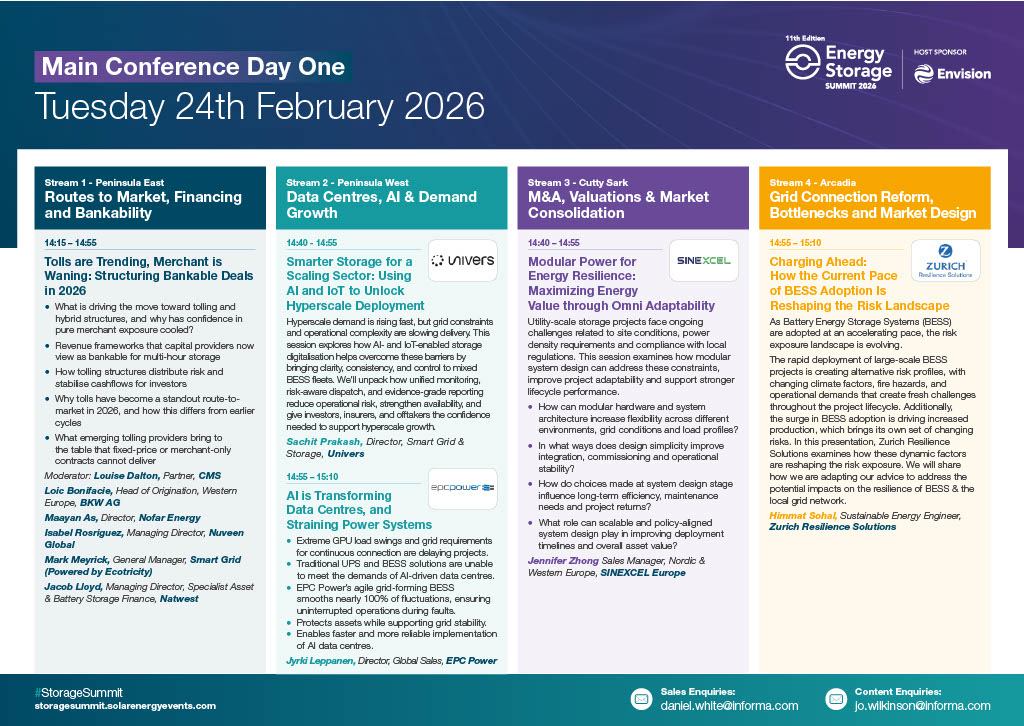
Hyperscale demand is rising fast, but grid constraints and operational complexity are slowing delivery. This session explores how AI- and IoT-enabled storage digitalisation helps overcome these barriers by bringing clarity, consistency, and control to mixed BESS fleets. We’ll unpack how unified monitoring, risk-aware dispatch, and evidence-grade reporting reduce operational risk, strengthen availability, and give investors, insurers, and offtakers the confidence needed to support hyperscale growth.
![]()


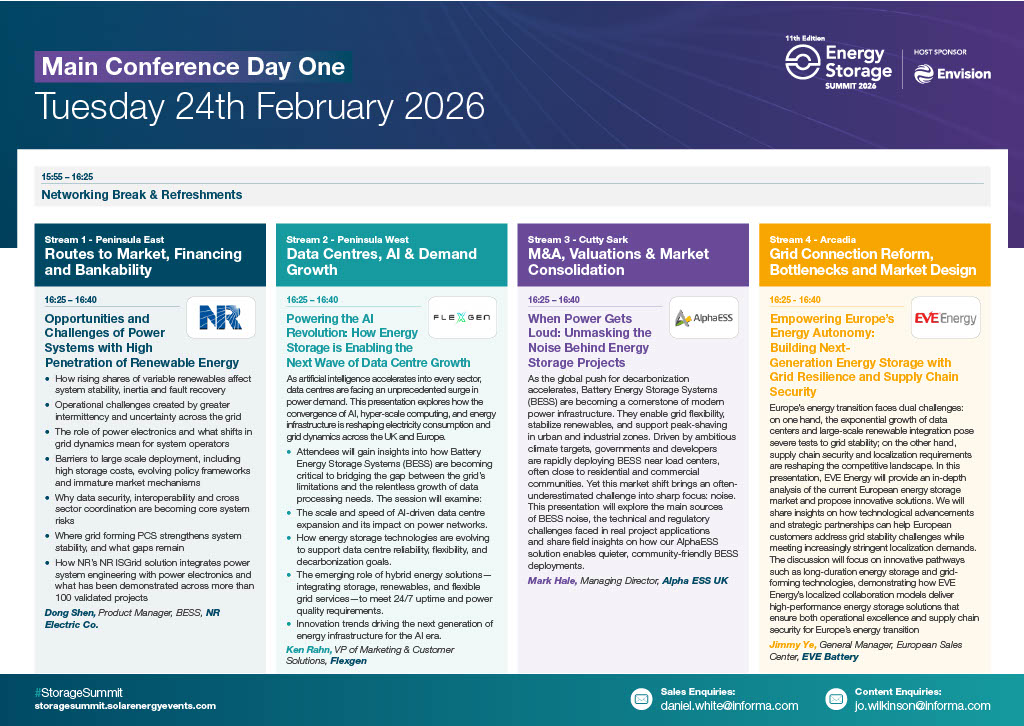
As artificial intelligence accelerates into every sector, data centres are facing an unprecedented surge in power demand. This presentation explores how the convergence of AI, hyperscale computing, and energy infrastructure is reshaping electricity consumption and grid dynamics across the UK and Europe.
Attendees will gain insights into how Battery Energy Storage Systems (BESS) are becoming critical to bridging the gap between the grid’s limitations and the relentless growth of data processing needs. The session will examine:
This session will outline the opportunities and challenges for developers, utilities, and investors at the crossroads of digital and energy transformation—and how storage can be the linchpin in powering the world’s growing digital intelligence sustainably.
![]()
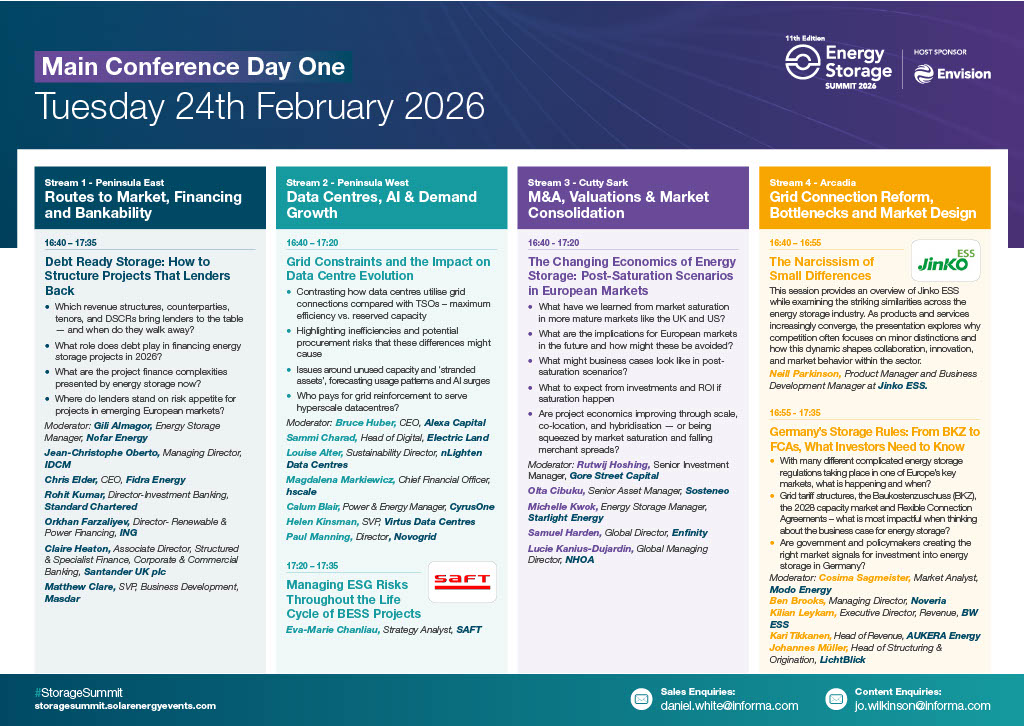
Compliance with Environmental, Social and Governance standards is a must for any Energy Storage developer and operator, and an increasingly complex task in a world of international regulation, diversified supply chains and rapidly evolving technologies.
Saft has developed a comprehensive approach to anticipate, fulfil and often go beyond such requirements. In this presentation we will focus on some aspects considered as critical by our customers, and highlight how to prepare the future taking the EU Battery Regulation as a guidance document:
The importance of a global approach to ESG, with specific focus on three elements:
Navigating the EU Battery Regulation
![]()
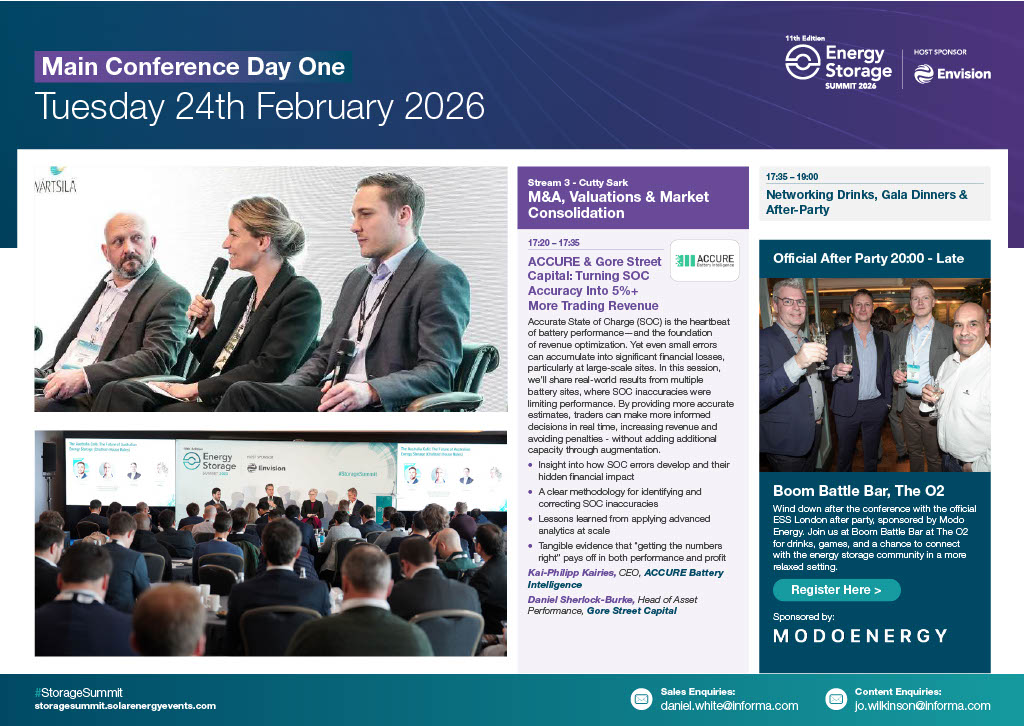
As Day 1 of the Energy Storage Summit comes to a close, we invite you to join us for a drinks reception to continue the conversations and build new connections.
Wind down after the conference with the official ESS London after party, sponsored by Modo Energy. Join us at Boom Battle Bar at The O2 for drinks, games, and a chance to connect with the energy storage community in a more relaxed setting.
Register Here > https://utm.io/ujydy
Sponsored by:
![]()
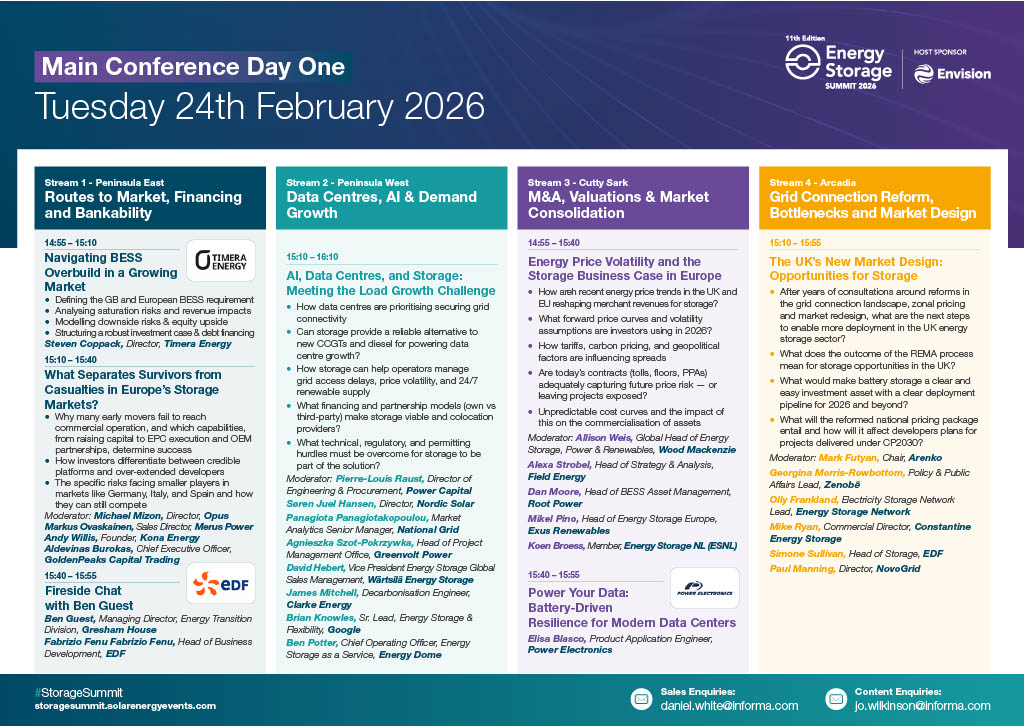
The energy storage M&A landscape is shifting as the sector matures and investment expectations change. This session explores how market conditions, revenue visibility and risk perception are influencing deal appetite and valuation trends.

Utility-scale storage projects face ongoing challenges related to site conditions, power density requirements and compliance with local regulations. This session examines how modular system design can address these constraints, improve project adaptability and support stronger lifecycle performance.

As Battery Energy Storage Systems (BESS) are adopted at an accelerating pace, the risk exposure landscape is evolving.
The rapid deployment of large-scale BESS projects is creating alternative risk profiles, with changing climate factors, fire hazards, and operational demands that create fresh challenges throughout the project lifecycle. Additionally, the surge in BESS adoption is driving increased production, which brings its own set of changing risks. In this presentation, Zurich Resilience Solutions examines how these dynamic factors are reshaping the risk exposure. We will share how we are adapting our advice to address the potential impacts on the resilience of BESS & the local grid network.

![]()
As the global push for decarbonization accelerates, Battery Energy Storage Systems (BESS) are becoming a cornerstone of modern power infrastructure. They enable grid flexibility, stabilize renewables, and support peak-shaving in urban and industrial zones. Driven by ambitious climate targets, governments and developers are rapidly deploying BESS near load centers, often close to residential and commercial communities. Yet this market shift brings an often underestimated challenge into sharp focus: noise. This presentation will explore the main sources of BESS noise, the technical and regulatory challenges faced in real project applications, and share field insights on how our AlphaESS solution enables quieter, community-friendly BESS deployments.

Europe’s energy transition faces dual challenges: on one hand, the exponential growth of data centers and large-scale renewable integration pose severe tests to grid stability; on the other hand, supply chain security and localization requirements are reshaping the competitive landscape. In this presentation, EVE Energy will provide an in-depth analysis of the current European energy storage market and propose innovative solutions. We will share insights on how technological advancements and strategic partnerships can help European customers address grid stability challenges while meeting increasingly stringent localization demands. The discussion will focus on innovative pathways such as long-duration energy storage and grid-forming technologies, demonstrating how EVE Energy’s localized collaboration models deliver high-performance energy storage solutions that ensure both operational excellence and supply chain security for Europe’s energy transition.
![]()

Accurate State of Charge (SOC) is the heartbeat of battery performance—and the foundation of revenue optimization. Yet, even small errors can accumulate into significant financial losses, particularly at large-scale sites.
In this session, we’ll share real-world results from multiple battery sites, where SOC inaccuracies were limiting performance. By providing more accurate estimates, traders can make more informed decisions in real time, increasing revenue and avoiding penalties – without adding additional capacity through augmentation.
Attendees will gain:
![]()
As Day 1 of the Energy Storage Summit comes to a close, we invite you to join us for a drinks reception to continue the conversations and build new connections.
Wind down after the conference with the official ESS London after party, sponsored by Modo Energy. Join us at Boom Battle Bar at The O2 for drinks, games, and a chance to connect with the energy storage community in a more relaxed setting.
Register Here > https://utm.io/ujydy
Sponsored by:
![]()
Join us on the morning of Day 2 for the Energy Storage Summit 5KM Fun Run, an active start before a full day of insights and discussion. This unique networking experience combines wellness with business development in a relaxed, engaging environment. This is a fantastic way to showcase your company’s commitment to employee wellness while connecting with key decision-makers from across the energy storage running community. View the route here.
To enquire about sponsorship of the run, contact: sm.energystorage@informa.com

![]()
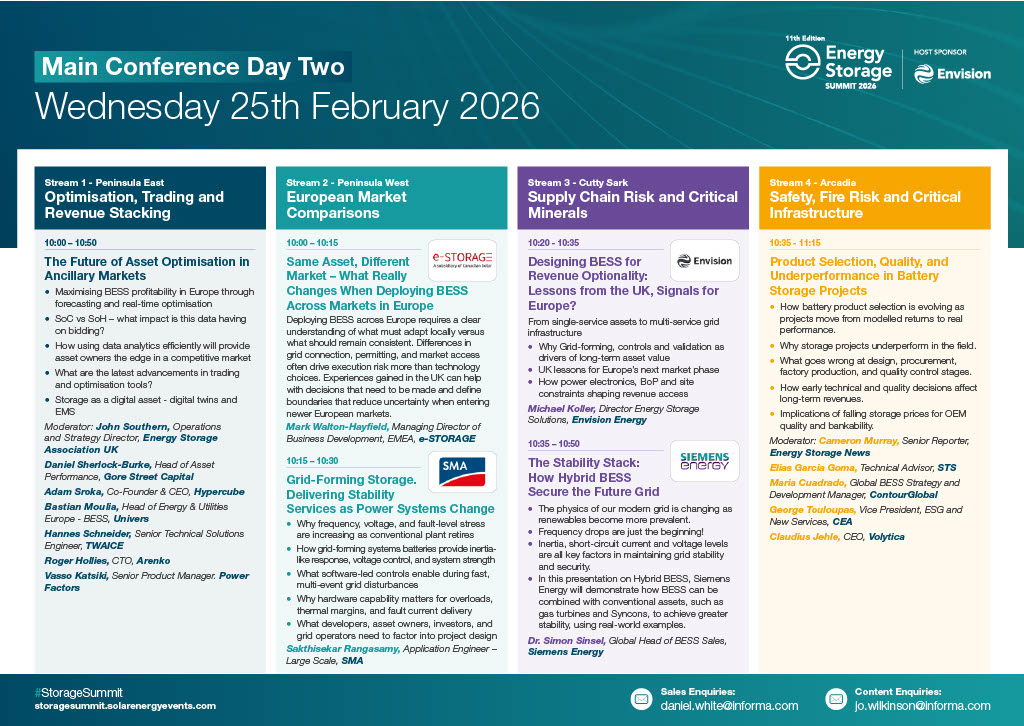
Deploying BESS across Europe requires a clear understanding of what must adapt locally versus what should remain consistent. Differences in grid connection, permitting, and market access often drive execution risk more than technology choices. Experiences gained in the UK can help with decisions that need to be made and define boundaries that reduce uncertainty when entering newer European markets.
![]()
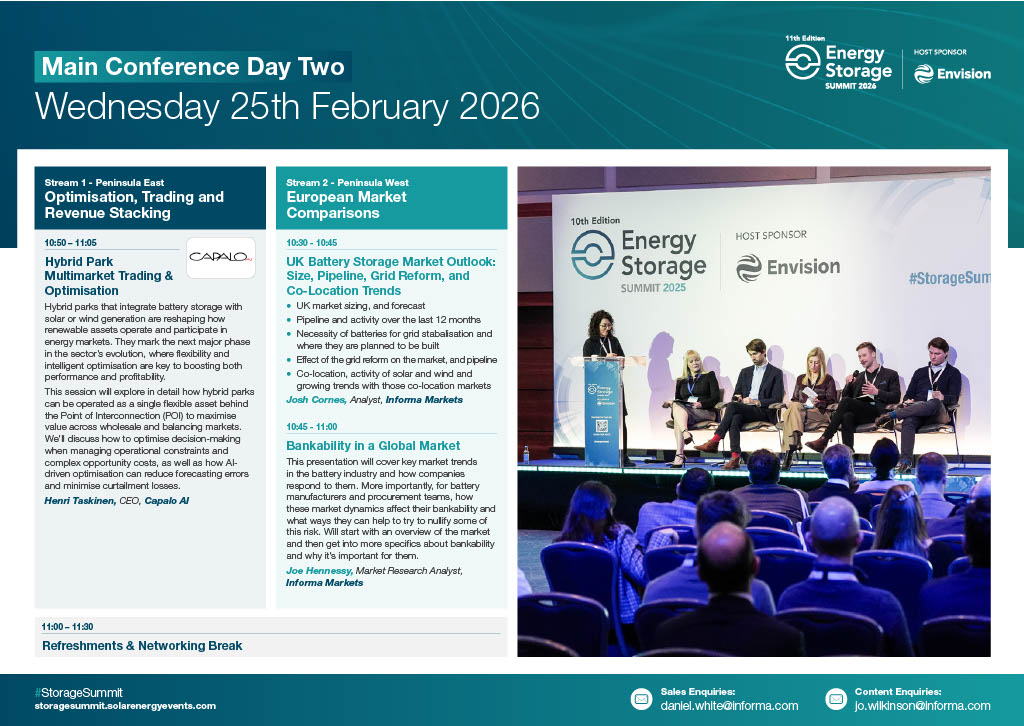
Hybrid parks that integrate battery storage with solar or wind generation are reshaping how renewable assets operate and participate in energy markets. They mark the next major phase in the sector’s evolution, where flexibility and intelligent optimisation are key to boosting both performance and profitability.
This session will explore in detail how hybrid parks can be operated as a single flexible asset behind the Point of Interconnection (POI) to maximise value across wholesale and balancing markets. We’ll discuss how to optimise decision-making when managing operational constraints and complex opportunity costs, as well as how AI-driven optimisation can reduce forecasting errors and minimise curtailment losses.
![]()
This presentation will cover key market trends in the battery industry and how companies respond to them. More importantly, for battery manufacturers and procurement teams, how these market dynamics affect their bankability and what ways they can help to try to nullify some of this risk. Will start with an overview of the market and then get into more specifics about bankability and why it’s important for them.

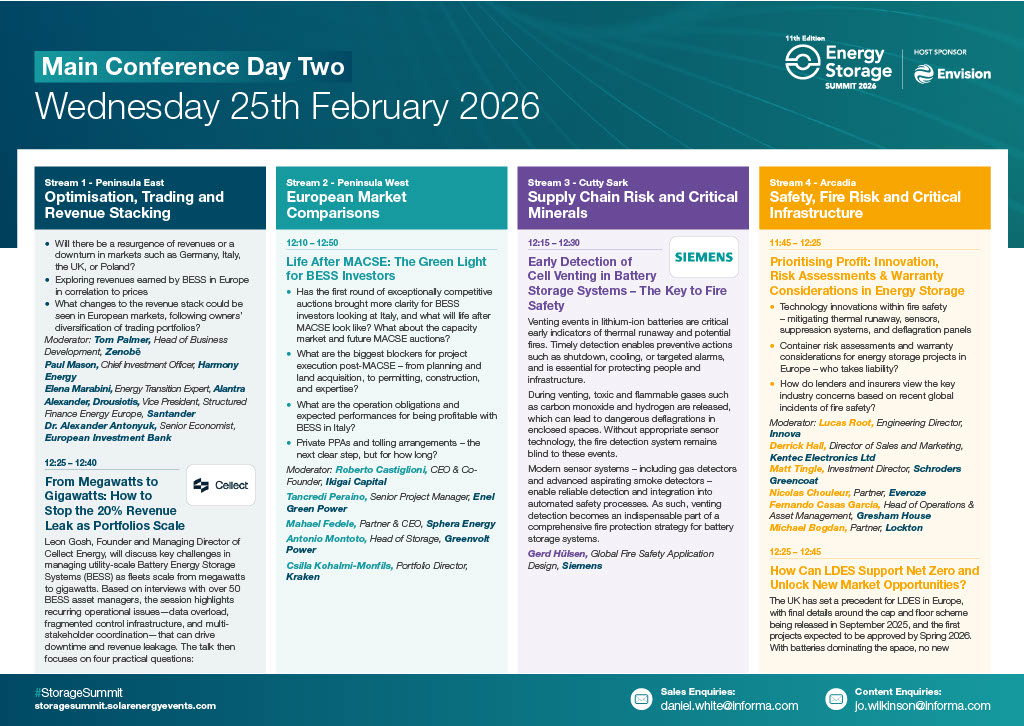
Leon Gosh, Founder and Managing Director of Cellect Energy, will discuss key challenges in managing utility-scale Battery Energy Storage Systems (BESS) as fleets scale from megawatts to gigawatts. Based on interviews with over 50 BESS asset managers, the session highlights recurring operational issues—data overload, fragmented control infrastructure, and multi-stakeholder coordination—that can drive downtime and revenue leakage. The talk then focuses on four practical questions:


![]()
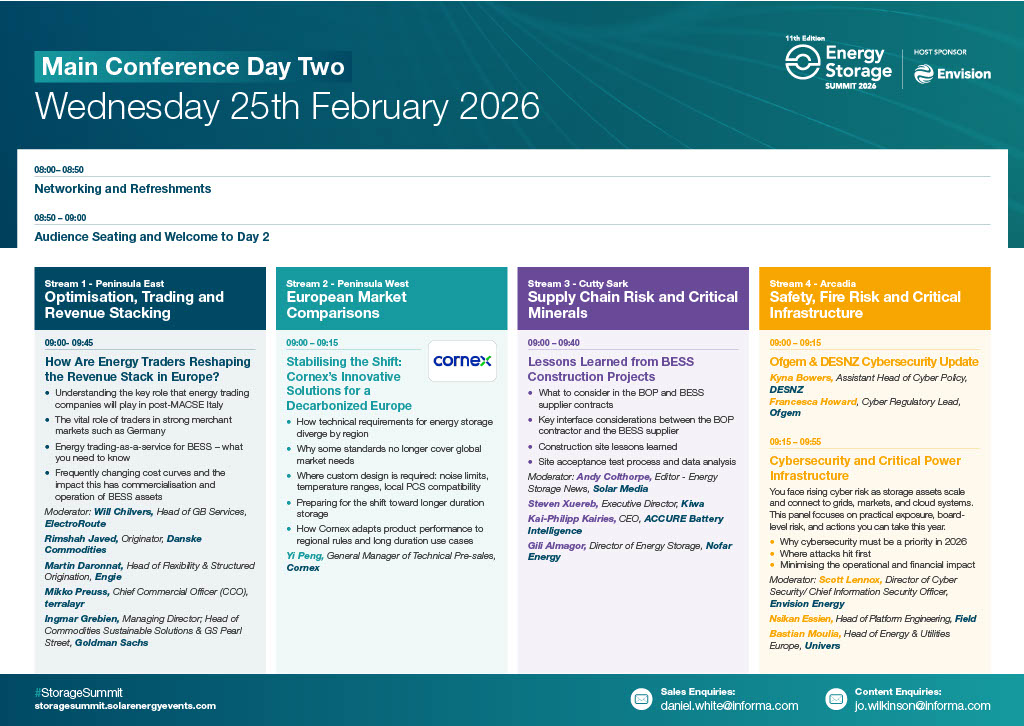
You face rising cyber risk as storage assets scale and connect to grids, markets, and cloud systems. This panel focuses on practical exposure, board-level risk, and actions you can take this year.
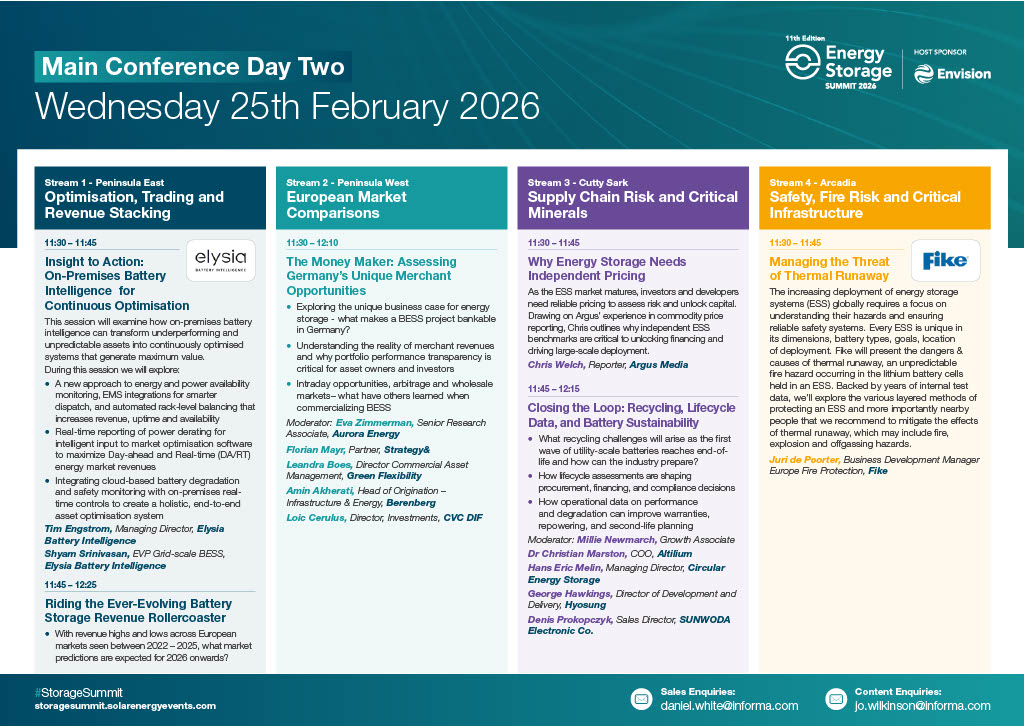
As the ESS market matures, investors and developers need reliable pricing to assess risk and unlock capital. Drawing on Argus’ experience in commodity price reporting, Chris outlines why independent ESS benchmarks are critical to unlocking financing and driving large-scale deployment.
The increasing deployment of energy storage systems (ESS) globally requires a focus on understanding their hazards and ensuring reliable safety systems. Every ESS is unique in its dimensions, battery types, goals, location of deployment. Fike will present the dangers and causes of thermal runaway, an unpredictable fire hazard occurring in the lithium battery cells held in an ESS. Backed by years of internal test data, we’ll explore the various layered methods of protecting an ESS and, more importantly, nearby people that we recommend to mitigate the effects of thermal runaway, which may include fire, explosion and off-gassing hazards.

Venting events in lithium-ion batteries are critical early indicators of thermal runaway and potential fires. Timely detection enables preventive actions such as shutdown, cooling, or targeted alarms, and is essential for protecting people and infrastructure.
During venting, toxic and flammable gases such as carbon monoxide and hydrogen are released, which can lead to dangerous deflagrations in enclosed spaces. Without appropriate sensor technology, the fire detection system remains blind to these events.
Modern sensor systems – including gas detectors and advanced aspirating smoke detectors – enable reliable detection and integration into automated safety processes. As such, venting detection becomes an indispensable part of a comprehensive fire protection strategy for battery storage systems.
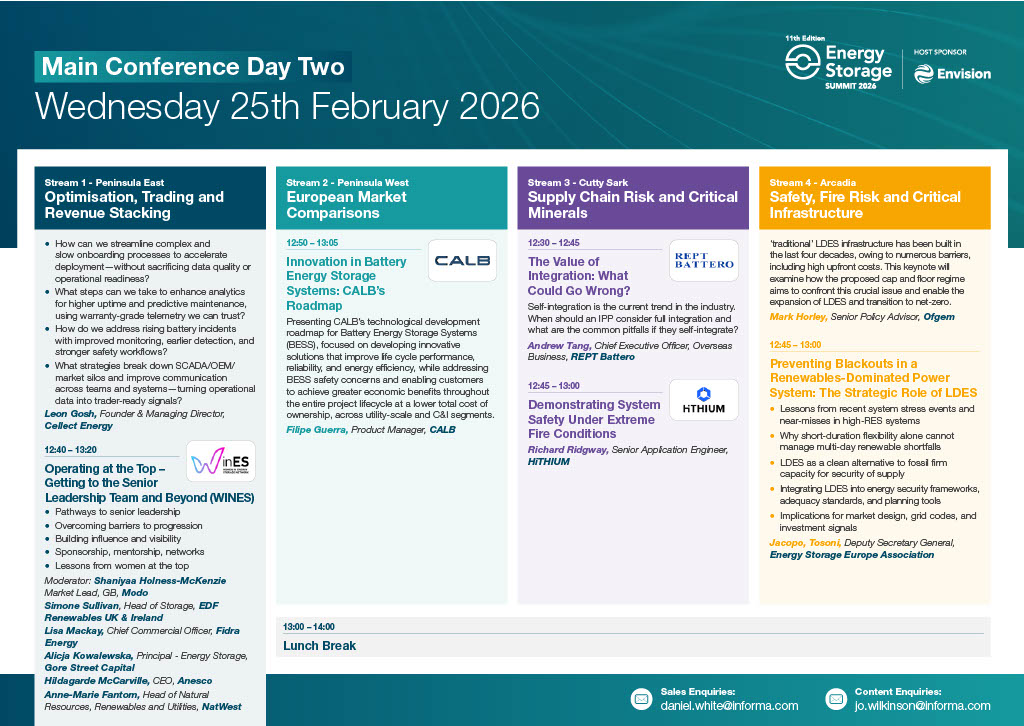
Self-integration is the current trend in the industry. When should an IPP consider full integration and what are the common pitfalls if they self-integrate?
![]()
122The UK has set a precedent for LDES in Europe, with final details around the cap and floor scheme being released in September 2025, and the first projects expected to be approved by Spring 2026. With batteries dominating the space, no new ‘traditional’ LDES infrastructure has been built in the last four decades, owing to numerous barriers, including high upfront costs. This keynote will examine how the proposed cap and floor regime aims to confront this crucial issue and enable the expansion of LDES and transition to net-zero.